
Biosamples from RECOVER clinical trials offer expanded opportunities for Long COVID research

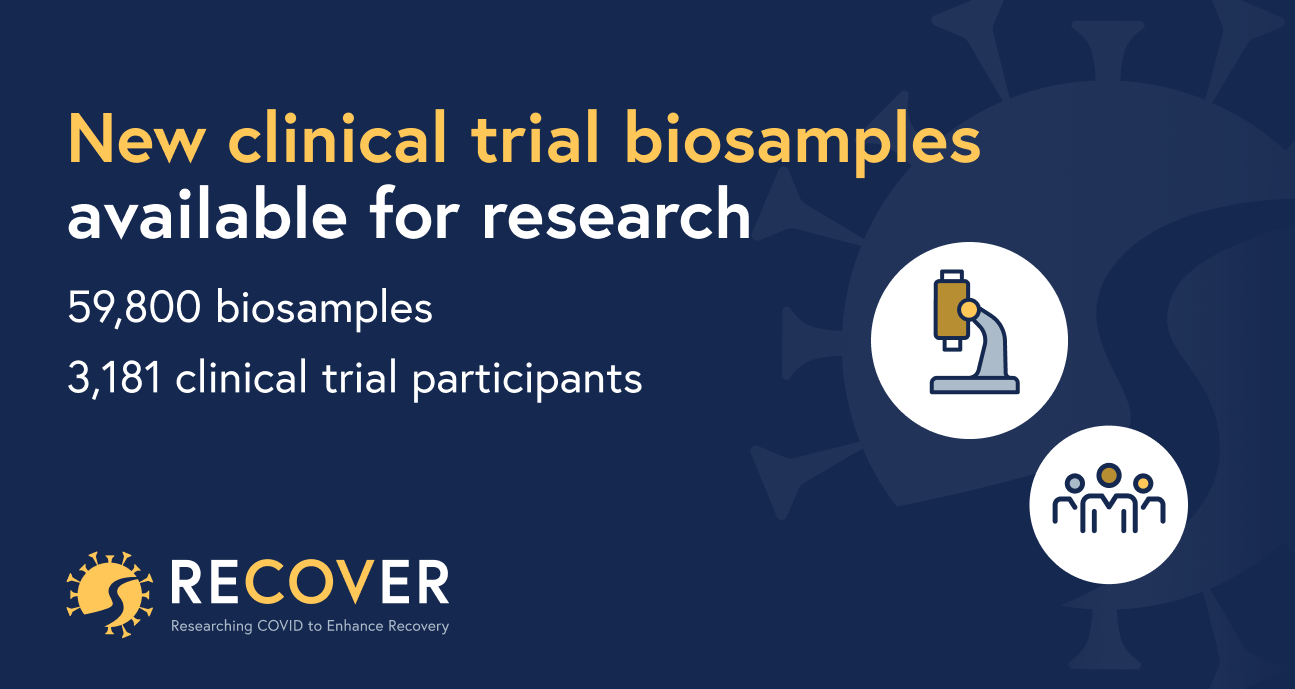
Nearly 60,000 biosamples collected from more than 3,000 clinical trial participants will provide valuable information to researchers about how people’s bodies respond to study treatments.
A recent RECOVER Research Opportunity Announcement (ROA OTA-21-015L) provides researchers with a new opportunity to study Long COVID using data and biosamples collected from participants in RECOVER’s observational studies and clinical trials. Information from RECOVER’s Clinical Trials (RECOVER-CT) program is newly available for this type of research, offering another way for researchers to use valuable resources from the RECOVER Initiative to expand the types of scientific questions they can ask about Long COVID.
The data and biosamples from RECOVER-CT are the next step in RECOVER’s commitment to sharing resources collected from its studies to advance Long COVID research. This expansion adds nearly 60,000 biosamples collected from 3,181 clinical trial participants to the more than 82 million data points and 1.5 million biosamples that RECOVER has already made available from its observational studies.
Together, these datapoints and samples make up one of the world’s most comprehensive Long COVID datasets. These resources can help eligible researchers study different biological mechanisms (changes in the body) associated with Long COVID.
Interested researchers both within and outside of RECOVER can submit a study plan describing how they would use RECOVER’s data and biosamples to answer important questions about Long COVID, beyond the initiative’s primary research aims. Select study teams will receive access to the requested biosamples and funding to carry out the study.
Biosamples collected during clinical trials
The RECOVER-CT program included 8 clinical trials testing 13 possible treatments across 5 focus areas: autonomic dysfunction, cognitive dysfunction, exercise intolerance and fatigue, sleep disturbances, and viral persistence.
RECOVER-CT biosamples were collected from all participants before the clinical trial began, and were also collected at different points during the specific clinical trials. Biosample collection varied across the 8 trials. Available clinical trial biosamples include:
- Whole blood and parts of blood—for example, plasma, serum, and peripheral blood mononuclear cells (PBMCs)
- Stool (poop)
- RNA (ribonucleic acid, a molecule that supports many cell functions)
The value of examining treatment response
For researchers, the value of these samples comes not only from their number and variety, but also from the context in which they were collected. During clinical trials, many participants receive a possible treatment being tested by the study. When researchers study clinical trial biosamples, they will be able to link these study treatments, and other information from clinical trials, with biological mechanisms. This linkage opens the door to explore treatment response—that is, what happened inside people’s bodies after they took the test treatment.
“The biosamples from RECOVER Clinical Trials represent a spectacular resource to better understand Long COVID,” said Jason Goldman, MD, Mechanistic Committee Co-Chair for RECOVER. “Doing ‘mechanistic’ studies with biosamples from clinical trials can help us look inside the body to understand why a certain study treatment did or did not work to help specific individuals feel better. These opportunities are especially important because Long COVID likely involves different biological pathways in different people. Doing studies with biosamples from clinical trials can inform biomarker development and can bring us closer to informing targeted treatments.”
Researchers could also request to compare findings across groups of people who received different study treatments, or develop a study that includes biosamples from both clinical trials and observational studies. Of particular interest are data and biosamples from a unique subset of participants who took part in both the observational study and at least one clinical trial.
How researchers can access these biosamples
Researchers can explore the biosamples that are available by viewing the RECOVER-CT Biospecimen Inventory Summary. This resource can help researchers to begin determining which biosamples may be the best fit to address their research questions. Clinical trial data will also soon be available via BioData Catalyst Powered by PIC-SURE (BDC-PIC-SURE).
Researchers who are interested in applying for funding through RECOVER’s Research Opportunity Announcement must first submit an online request form to determine whether the data and biosamples needed to support their research project are available. Researchers must describe the samples they need and the questions they hope to answer. If the biosamples are available, researchers can then apply for funding.
Applications will be accepted on a rolling basis while this Research Opportunity remains open. The opportunity will remain open until further notice from the National Institutes of Health (NIH).
Researchers can learn about this opportunity by reading the funding announcement. Interested applicants can start their application at the Research Opportunity Announcement OTA-21-015L webpage.
