
RECOVER continues to focus on understanding symptoms that affect the brain

As RECOVER enters the next phase of its adult observational study, researchers will take a deeper look at how the brain interacts with the rest of the body—and how these connections may lead to symptoms like brain fog.
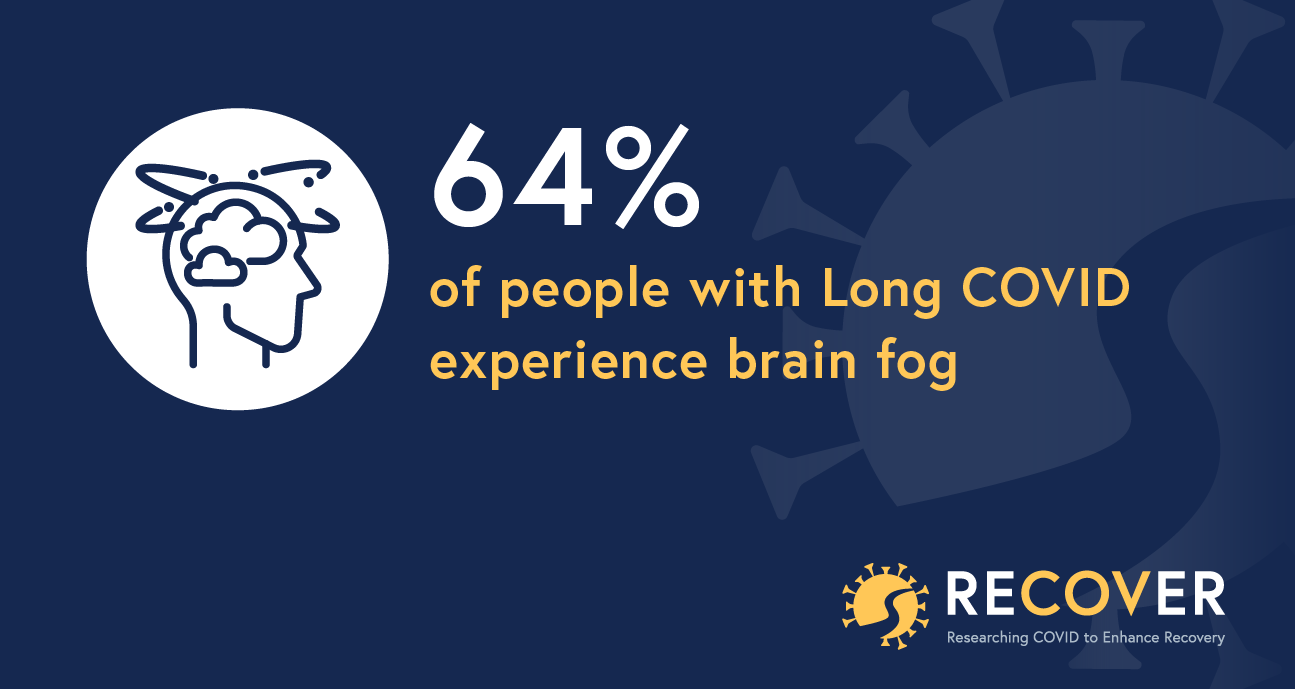
Cognitive symptoms (such as trouble thinking clearly, remembering things, and concentrating) are among the most common challenges reported by people with Long COVID. A 2024 RECOVER study found that 64% of people likely to have Long COVID reported these symptoms, often described by the term “brain fog.” Despite how common they are, brain-related symptoms remain some of the most burdensome and least understood, said Jacqueline Becker, PhD, a RECOVER researcher, neurocognitive lead for the next phase of RECOVER’s adult observational study, and clinical neuropsychologist, who studies the brain and how it functions.
“These symptoms can affect nearly every part of daily life, from work to relationships. But we still don’t fully understand why they happen, which makes them difficult to treat,” said Dr. Becker.
RECOVER researchers have observed that cognitive symptoms rarely appear in isolation. Rather, they often appear alongside other symptoms, such as poor sleep, depression, post-exertional malaise (symptoms that get worse after physical, mental, or emotional activity), or cardiopulmonary issues (problems with the heart and lungs). This overlap makes it difficult to pinpoint what’s driving brain fog in any one person.
“’Brain fog’ is a catch-all term people use, but it likely reflects many different underlying problems,” Dr. Becker said. “In most cases, there isn’t one thing that causes brain fog, but rather a combination of factors.”
As an example, she explained that in some people, brain fog might be linked to neuroinflammation (an immune response in the brain that can be triggered by infections like SARS-CoV-2, the virus that causes COVID-19). In others, especially those with cardiopulmonary issues, reduced oxygen flow to the brain may play a role instead.
In the next phase of RECOVER observational studies, researchers plan to “put brain health front and center” by collecting more detailed data on cognition and how it relates to other body systems. Dr. Becker will discuss key gaps in Long COVID neurocognitive research and how RECOVER plans to address them, at an upcoming R3 Seminar on April 14. Register for the webinar.
Early RECOVER studies identify and define cognitive symptoms
During the first phase of RECOVER’s observational studies, researchers confirmed that brain fog is one of the most common and burdensome Long COVID symptoms. These findings helped guide the design of clinical trials, including RECOVER-NEURO—a trial that tested 3 potential treatments for cognitive symptoms. Dr. Becker served as one of its principal investigators.
Dr. Becker and other RECOVER researchers are also finalizing a paper on cognitive findings from the first phase of the adult observational study, which used the NIH Toolbox, a research instrument that measures memory, attention, language, and other brain functions, to assess participants, among other instruments.
“Brain fog doesn't have a simple diagnostic test, so we have to look at it from multiple angles.” Dr. Becker said. “What we measure on our tests and what patients report in their daily lives gives us equally important and complementary information that gives us a much clearer picture.”
Another important finding from RECOVER’s adult observational study revealed a connection between smell loss and self-reported cognitive symptoms. Among participants who underwent formal smell testing, those with confirmed smell loss were more likely to also report brain fog. In the next phase, researchers will build on this connection by combining smell testing with more precise cognitive assessments.
Next steps for RECOVER neurocognitive research
To move RECOVER’s neurocognitive studies forward, researchers will use more targeted and sensitive cognitive tests that are more ideally suited for study participants, rather than broader tools that may miss subtle changes. By following participants over a longer period, researchers hope to answer critical questions that earlier studies could not.
For example, does Long COVID cause short-term disruptions in brain function or measurable long-term damage to the brain? By tracking inflammation (an immune response to infection) and signs of damage to the brain’s nerve cells over time, researchers can determine if symptoms get better as inflammation decreases or if cognitive problems are longer lasting.
Researchers will also examine whether Long COVID increases the risk of developing conditions such as Alzheimer’s disease, by tracking changes in brain health over several years.
A key focus forward will be understanding how the brain connects with other systems in the body, especially that heart, lungs, and autonomic nervous system (which controls automatic functions like heart rate and breathing). “We’re starting to see patterns in how different body systems interact,” Dr. Becker said. “For some patients, these systems are deeply interconnected, and that may help explain why symptoms tend to cluster together.”
Ultimately, RECOVER researchers aim to separate cognitive symptoms caused directly by changes in the brain from those driven by other body systems. This distinction is critical. By understanding what’s behind brain fog in different patients, researchers can develop more targeted treatments and test them in future clinical trials.
“The goal is to move from describing these symptoms to actually treating them,” Dr. Becker said. “To do that, we first need to understand what’s really driving them.”
