
RECOVER hub brings Long COVID research to rural, low-income communities

By enrolling nearly 10% of the initiative’s adult observational study participants, the IDeA States Consortium for Clinical Research (ISCORE) helped ensure that communities often left out of research are included in RECOVER studies.
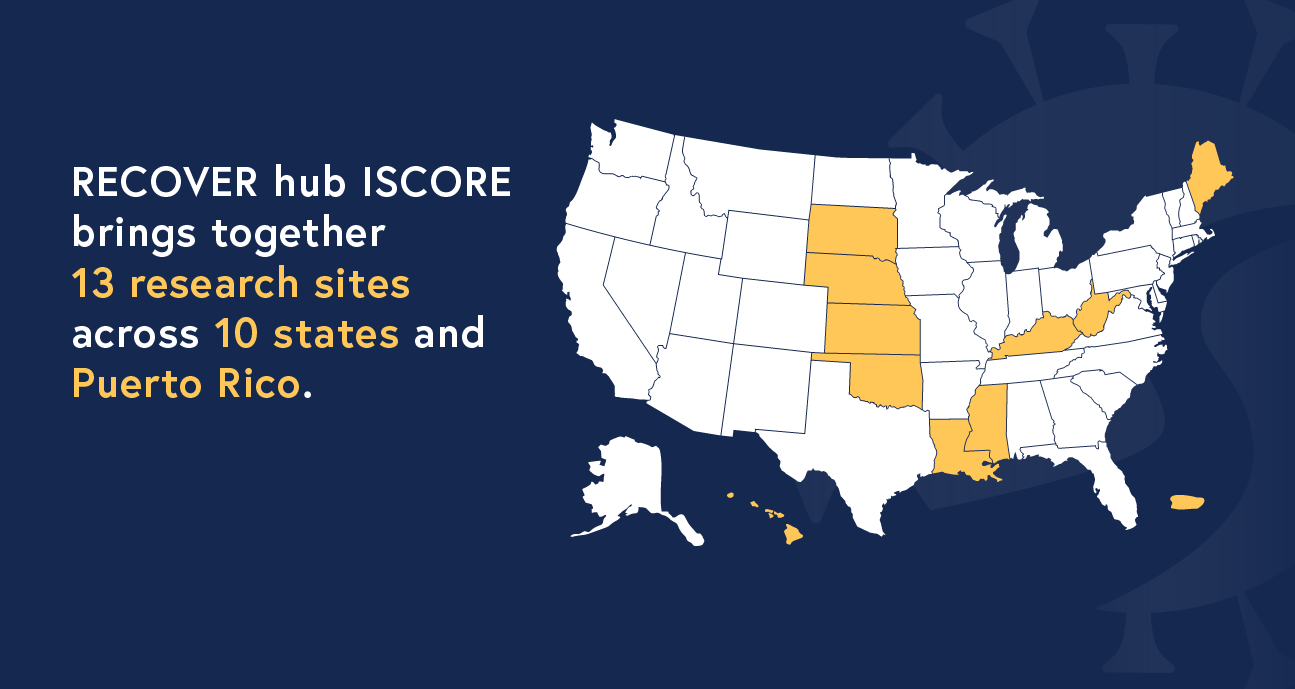
A network of 13 research sites stretching from Maine to Hawaii and Puerto Rico is working together to make sure people who live in communities with historically fewer research opportunities can take part in Long COVID research.
The IDeA State Consortium for Clinical Research (ISCORE) is a clinical trial network with RECOVER research sites spanning 10 U.S. states, from Maine to Hawaii, and 1 U.S. territory (Puerto Rico). ISCORE sites are located in areas of the U.S. with traditionally low numbers of NIH clinical trial participants. The ISCORE hub is based at the West Virginia Clinical and Translational Science Institute (WVCTSI) located at West Virginia University. WVCTSI is supported by the Institutional Development Award for Clinical and Translational Research (IDeA-CTR), a program of the National Institute of General Medical Sciences that seeks to build clinical and translational research in states historically receiving lower levels of NIH funding.
“The commonality among ISCORE site investigators and staff, despite the broad geographic spread, is that they are dedicated to bringing clinical studies to the populations that they serve,” said Sally Hodder, MD, an infectious disease physician, WVCTSI principal investigator (PI), and co-PI of the RECOVER ISCORE hub. “The idea is that an individual’s ability to enroll in a clinical study should not be limited by where they live.”
A network built during the COVID-19 pandemic
During the COVID-19 pandemic, WVCTSI joined forces with other IDeA-CTRs and Clinical and Translational Science Award (CTSA) programs in IDeA states across the country, constituting the ISCORE Network. Together, they studied how COVID was affecting their communities. An early ISCORE project demonstrated that mortality among hospitalized acute COVID-19 patients in rural areas was significantly higher compared with urban areas. The resulting publication was selected as the Paper of the Year by the Journal of Rural Health.
When RECOVER announced its call for research hubs, Dr. Hodder and co-PI Cliff Rosen, MD, of Maine Medical Center, saw an opportunity to expand the network and broaden its research focus to include Long COVID. In addition to the IDeA-CTRs and one CTSA that were already part of ISCORE, the Sanford Health system in South Dakota and the University of Kansas CTSA joined the network. Each ISCORE site brings a unique perspective focused on the groups of people they serve, including native Hawaiian, American Indian, Black, Hispanic, and rural communities.
Working together to support participants across sites
As part of the first phase of RECOVER's adult observational study, ISCORE enrolled nearly 10% of the total study population. ISCORE also retained 85% of their participants through the end of the study in October 2025.
During the early years of the first RECOVER phase, ISCORE sites met weekly on Tuesdays despite the wide spread of time zones. Although the meeting fell outside of traditional working hours for some sites, meetings were well attended. “Attendance at Tuesday meetings was excellent with nearly every site represented,” Dr. Hodder said.
During the enrollment phase, the weekly meetings reviewed data to understand how each site was performing in participant enrollment and retention. Those sites with outstanding enrollment and retention metrics shared their strategies and discussed best practices. The Alliance for Clinical and Translational Research in Puerto Rico had the strongest retention in the network, with only one participant not completing the study.
ISCORE works to keep RECOVER study participants engaged through several approaches:
- A Community Advisory Board. Led by Dr. Rosen, the board meets quarterly and brings together community members and investigators from multiple ISCORE sites. It serves 2 purposes: gathering feedback on their RECOVER experience and providing peer support among members who share similar health challenges.
- Hybrid events. A hybrid in-person and virtual event last year brought ISCORE participants and researchers together to discuss key RECOVER findings. One piece of information that was especially important to patients, Dr. Hodder shared, was the finding that routine lab work often appears normal in Long COVID patients despite the symptoms they experience.
- Support for study visits. As transportation is a barrier to clinical research participation, particularly among rural residents, sites reimbursed mileage, offered transportation services, and provided food stipends and even hotel rooms when participants needed to travel long distances for required clinic visits. For participants who moved out of state during the study, some sites offered flights to enable in-person attendance at annual study visits.
- Newsletters, holiday cards, and appreciation gifts. RECOVER’s Clinical Science Core (CSC) created regular newsletters and holiday cards for the hub to keep in touch with study participants. Connie Cerullo, ISCORE RECOVER Hub project manager, supported digital distribution of these materials to sites. To recognize participants’ time and contributions, RECOVER also supplied appreciation gifts such as tote bags, notebooks, and eye masks to hubs for distribution.
Important research findings are also emerging from the ISCORE Network. Dr. Rosen led a RECOVER pathobiology study examining the impact of Long COVID on various parts of the body, including fat cells. Dr. Gailen Marshall, University of Mississippi Medical Center, led a study outside of RECOVER assessing whether a dietary supplement called Immulina could help manage Long COVID symptoms. ISCORE investigators are also examining how Long COVID has impacted rural compared with urban communities.
Of the 13 original ISCORE sites, 11 are moving into the next phase of RECOVER’s adult observational study, allowing for longer follow-up, which is essential to understanding how Long COVID develops over time. “Long COVID has a lot to teach us about post-infectious disease sequalae,” Dr. Hodder said. This new phase will require fewer clinic visits, making the study less burdensome for study participants and sites, yet is critically important to understand the natural history of Long COVID as well as impact on the development and/or course of related chronic diseases.
Bringing HIV experience to Long COVID clinical trials
As an intern at the University of California, San Francisco, in 1980, Dr. Hodder worked with AIDS patients before the disease had a name. That experience sparked her interest in infectious disease, and she spent the next 4 decades working on HIV—training at the University of California San Francisco and Case Western Reserve University, doing fieldwork in Kenya, and running early clinical trials in the 1990s that helped transform HIV into a condition that could be managed with medication. She later focused on HIV treatment and prevention for women in Newark, New Jersey. “I’ve seen how clinical trials actually are the difference between life and death,” said Dr. Hodder.
In addition to their work on RECOVER’s observational studies, ISCORE sites are also offering participants access to a growing number of Long COVID clinical trials.
The hub participated in the RECOVER-Clinical Trials (RECOVER-CT) program, with ISCORE sites recruiting participants for RECOVER-VITAL, RECOVER-NEURO, RECOVER-ENERGIZE, and RECOVER-SLEEP. Currently, the West Virginia site is enrolling participants in REVERSE-LC, a trial that is part of RECOVER’s next phase of clinical trials. Led by Dr. Wes Ely at Vanderbilt University Medical Center, this trial will test whether the drug baricitinib can improve brain function, heart and lung function, and quality of life for adults with Long COVID. Learn more about REVERSE-LC.
For Dr. Hodder and many others, Long COVID feels familiar. Like HIV, it is a serious illness that follows a viral infection, with patients continuing to suffer from its varied symptoms. Also like HIV, many questions about the condition remain unanswered. But she also recalls that science, dedicated investigators, committed funders, and many clinical trials transformed HIV infection from a near-certain death sentence to a manageable chronic disease. She believes that experience is part of what drives ISCORE Network sites to work together—a shared sense of urgency around a disease that is not completely understood, has no proven treatment, and is profoundly impacting people’s lives.
“We’ve had hard problems before, and we’ve found answers,” said Dr. Hodder. “I am confident that we will also find answers for this one.”
