
Researcher leads studies using electronic health data to understand Long COVID in children

Dr. Suchitra Rao collaborates on RECOVER studies that use electronic health record (EHR) data to understand how Long COVID can affect children and which treatments might offer them relief from their symptoms.
Even before she joined RECOVER, Suchitra Rao, MD (Children’s Hospital Colorado), witnessed the long-term impact COVID-19 can have on children’s health. “During the pandemic, we noticed that there was this segment of kids who were not getting better,” she said. “It was baffling. Why did some kids recover from their symptoms while other kids developed lingering, persistent symptoms?”
As she searched for answers to this question, Dr. Rao found that few research studies had investigated how COVID-19 can affect children—or whether it can affect them differently than it affects adults. She chose to join RECOVER to help close this gap. Her expertise in viral infections and experience as a healthcare provider positioned her to take a leadership role on RECOVER.
Since 2022, she has served as one of 3 principal investigators for studying health data collected from millions of children and adolescents (teenagers and young adults). Principal investigators design and oversee research studies, making sure they are conducted according to guidelines called protocols. Principal investigators also manage teams of researchers who write scientific publications about the studies and make sure study findings are shared with the broader scientific community.
Learn more about the different types of RECOVER studies and how they work together.
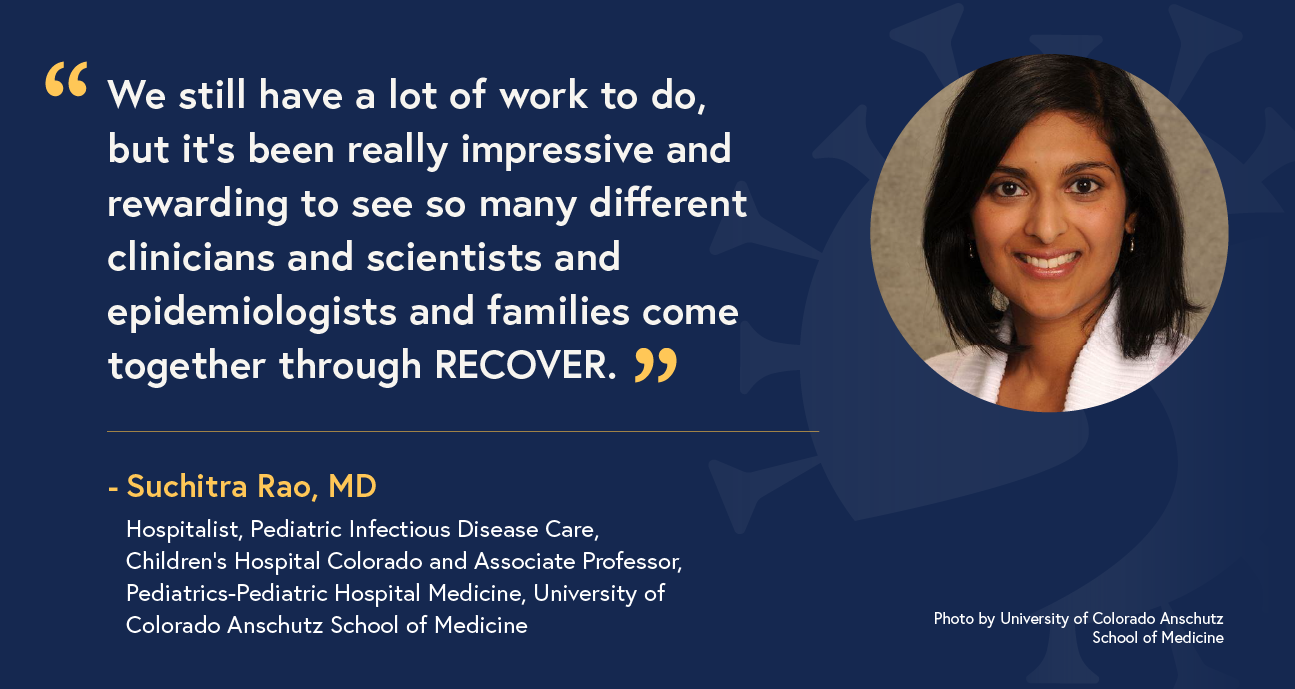
“We still have a lot of work to do, but it’s been really impressive and rewarding to see so many different clinicians and scientists and epidemiologists and families come together through RECOVER.” - Suchitra Rao, MD, Hospitalist, Pediatric Infectious Disease Care, Children's Hospital Colorado and Associate Professor, Pediatrics-Pediatric Hospital Medicine, U of Colorado Anschutz School of Medicine. Photo: University of Colorado Anschutz School of Medicine.
“Using data from millions of EHRs that we already had access to allowed us to hit the ground running while observational studies worked on enrolling tens of thousands of participants,” Dr. Rao explained. “That early EHR research helped us estimate how many children likely had Long COVID. It also helped us identify the most common symptoms of Long COVID in children, as well as important differences in the types of symptoms experienced by younger children compared to older children.”
Dr. Rao notes that, as much as these early findings advanced our understanding of Long COVID, they also generated brand-new questions about how to protect children from developing Long COVID. “Using what we learned, we looked at more EHR data and found that COVID-19 vaccines can help prevent Long COVID in both younger and older children,” Dr. Rao said. “We also found that this protective effect wanes over time, which highlights the need for ongoing vaccination.”
Another RECOVER EHR study found that children who got COVID-19 were not more likely to get other viral infections that can cause respiratory (lung- and airway-related) symptoms like cough and difficulty breathing. This study found that children who’d had COVID-19 between March and July 2022 did not face a higher risk of infection from respiratory syncytial virus (RSV), a very contagious virus that affects many children younger than age 2. “These findings are important since there was a theory that COVID-19 in children was weakening their immune system and putting them at risk of RSV infection, which led to the surge in cases we saw a couple of seasons ago,” she said. “Our study suggests that was not the case, and that there isn’t necessarily an increased risk of RSV or other infections in most children after they get COVID-19.”
To date, Dr. Rao has contributed to 37 RECOVER publications, either as an lead author, co-author, or member of a writing group. She is now focusing on an innovative type of EHR study that could help researchers find safe, effective treatments for Long COVID symptoms. This type of study is known as a target trial emulation (TTE) because it mimics randomized controlled clinical trials (like those that other RECOVER researchers are conducting) using existing EHR data.
“In a TTE, we can identify which Long COVID patients are receiving treatments, describe patterns in how they’re using those treatments, and measure how much those treatments have improved their symptoms,” Dr. Rao explained. “TTEs also offer distinct advantages. They can include many more participants and produce accurate results very quickly while often costing much less than traditional clinical trials.”
Moreover, conducting TTEs can help researchers overcome some of the difficulties associated with enrolling children in traditional clinical trials. “For example, drug doses appropriate for children often differ from the doses appropriate for adults, so extra work is needed to identify the ideal dose in children and adolescents of different ages,” she said. “It’s also usually harder to recruit children for treatment studies, especially if the disease is rare, or requires many clinic visits and medical procedures, like giving blood samples.”
RECOVER researchers recently published findings from a TTE study on Paxlovid, an anti-viral medication used to lessen the burden of COVID-19 symptoms. Additional TTE studies are underway for children and adults. The studies are evaluating several possible treatments, including:
- Baricitinib, a drug that suppresses (calms down) the immune system. Baricitinib has shown some promise in treating Long COVID symptoms affecting the heart and brain. RECOVER-Treating Long COVID (RECOVER-TLC) is also studying baricitinib using a randomized controlled clinical trial.
- SSRIs (selective serotonin reuptake inhibitors) and SNRIs (serotonin-norepinephrine reuptake inhibitors), drugs often prescribed to people experiencing depression. Some people with Long COVID report that taking SSRIs or SNRIs helps manage symptoms like fatigue (feeling extremely tired) and brain fog (having trouble thinking clearly, concentrating, or remembering things).
- Steroids, a class of drugs that reduce inflammation (swelling resulting from injury or infection). Researchers believe inflammation could be a leading cause of some Long COVID symptoms in some people.
- Naltrexone, a pain medication that may help prevent Long COVID. RECOVER-TLC is planning a clinical trial to study whether a low dose of naltrexone can help treat Long COVID-related fatigue in children, teens, and young adults (ages 6 to 25).
Dr. Rao contributes to RECOVER in many ways, but she remains committed to what first motivated her to get involved: improving all aspects of care for children with Long COVID. She’s thankful to have parents’ support in working toward this goal.
“We work closely with many parents in our research, and their voices and opinions matter,” she said. “Their experiences help to shape the work we are doing. Many of them have helped us determine the research questions we should be asking, assisted with the way we should design the study, and provided interpretations of findings and the overall message to incorporate into our publications. We still have a lot of work to do, but it’s been really impressive and rewarding to see so many different clinicians and scientists and epidemiologists and families come together through RECOVER.”
