News and Events
Stay informed about RECOVER’s Long COVID research by reading the latest news and participating in upcoming events.

Stay informed about RECOVER’s Long COVID research by reading the latest news and participating in upcoming events.
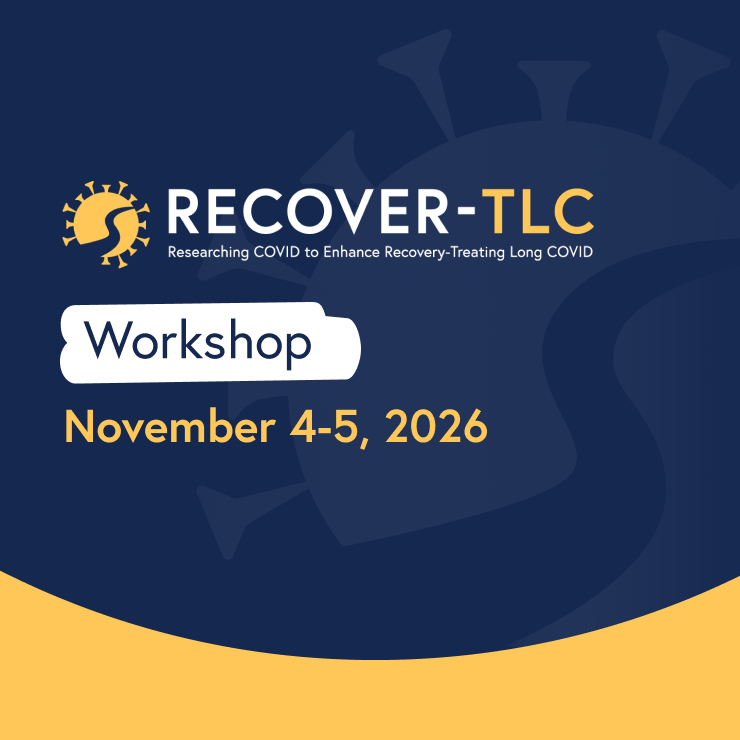
Registration is open for the third annual RECOVER-TLC Workshop, where researchers, clinicians, people living with Long COVID, and advocates will discuss the latest clinical trial updates and the future of Long COVID research.
The RECOVER-AUTONOMIC (Ivabradine) clinical trial tested whether ivabradine, an oral medication used to lower heart rate, could be used to manage a Long COVID symptom called postural orthostatic tachycardia syndrome (POTS).
RECOVER recognizes International Long COVID Awareness Day on March 15—a day established by the Long COVID community to increase visibility of the condition, share resources, and educate the public.
NIH and FNIH leaders will share insights and answer questions about the progress being made on the first wave of RECOVER-TLC clinical trials.
Researchers at 17 study sites across the US will test a possible treatment to help improve thinking and memory problems and reduce fatigue for people who have Long COVID.
Recent RECOVER publications include findings about possible causes of and treatments for Long COVID.
Dr. Suchitra Rao’s expertise helps RECOVER’s electronic health record (EHR) and observational studies make important discoveries about Long COVID in children.
Results from the RECOVER-AUTONOMIC Moderate POTS (Ivabradine) clinical trial will be presented at an upcoming session of the American College of Cardiology (ACC) Annual Conference on March 28, 2026.
During the February 10, 2026, RECOVER Research Review (R3) Seminar, RECOVER researchers Sarah Donohue, PhD, MPH, and Tanayott (Tony) Thaweethai, PhD, presented research on Long COVID trajectories in adults. Published in November 2025, this research—which includes participants from the initiative’s adult observational cohort study—explores different clinical presentations of Long COVID and how the condition progresses over time. RECOVER Patient Representative and co-author Mady Hornig, MD, MA, and Timothy Henrich, MD, MMSc, a Long COVID researcher, also shared their perspectives and experiences.